Intelerad vs Medicai for Enterprise Imaging Solutions
Many hospital IT teams are choosing between Intelerad and Medicai when they need a new enterprise imaging vendor. The decision affects how fast radiologists can access prior studies across sites and how much their PACS budget will grow next year.
By the end of this article you will see the concrete differences in their cloud PACS architectures, which platform supports AI structured reporting without extra licensing, and the exact pricing models each uses. You will also know which buyer profile fits Medicai and which one fits Intelerad.
Quick Verdict: Intelerad vs Medicai for Enterprise Imaging Solutions
Medicai provides a cloud-based platform with 1M+ studies processed annually and 50M+ yearly API transactions, while Intelerad offers established on-premise and hybrid solutions.
Facilities choosing between these platforms face clear differences in deployment models. Medicai operates as a cloud imaging solution with HIPAA and GDPR compliance along with a zero-footprint viewer. Intelerad typically emphasizes on-premise strengths that require local infrastructure management.
Medicai has delivered 300k+ DICOM visualizations in the past year through its FDA cleared viewers. This track record demonstrates the platform's capacity to handle enterprise imaging demands at scale across multiple clinical environments.
Facilities must weigh deployment model preferences carefully against multi-site scalability requirements. Cloud imaging solutions like Medicai support distributed healthcare networks without additional hardware investments. On-premise systems may provide greater local control but often require significant infrastructure commitments for expansion.
At a glance: how Medicai compares to Intelerad, Medicai for Enterprise Imaging Solutions on the features that matter most.
| Feature | Medicai | Intelerad | Medicai for Enterprise Imaging Solutions |
|---|---|---|---|
| Enterprise Imaging Solutions | ✓ | ✓ | ✓ |
What Is Medicai?
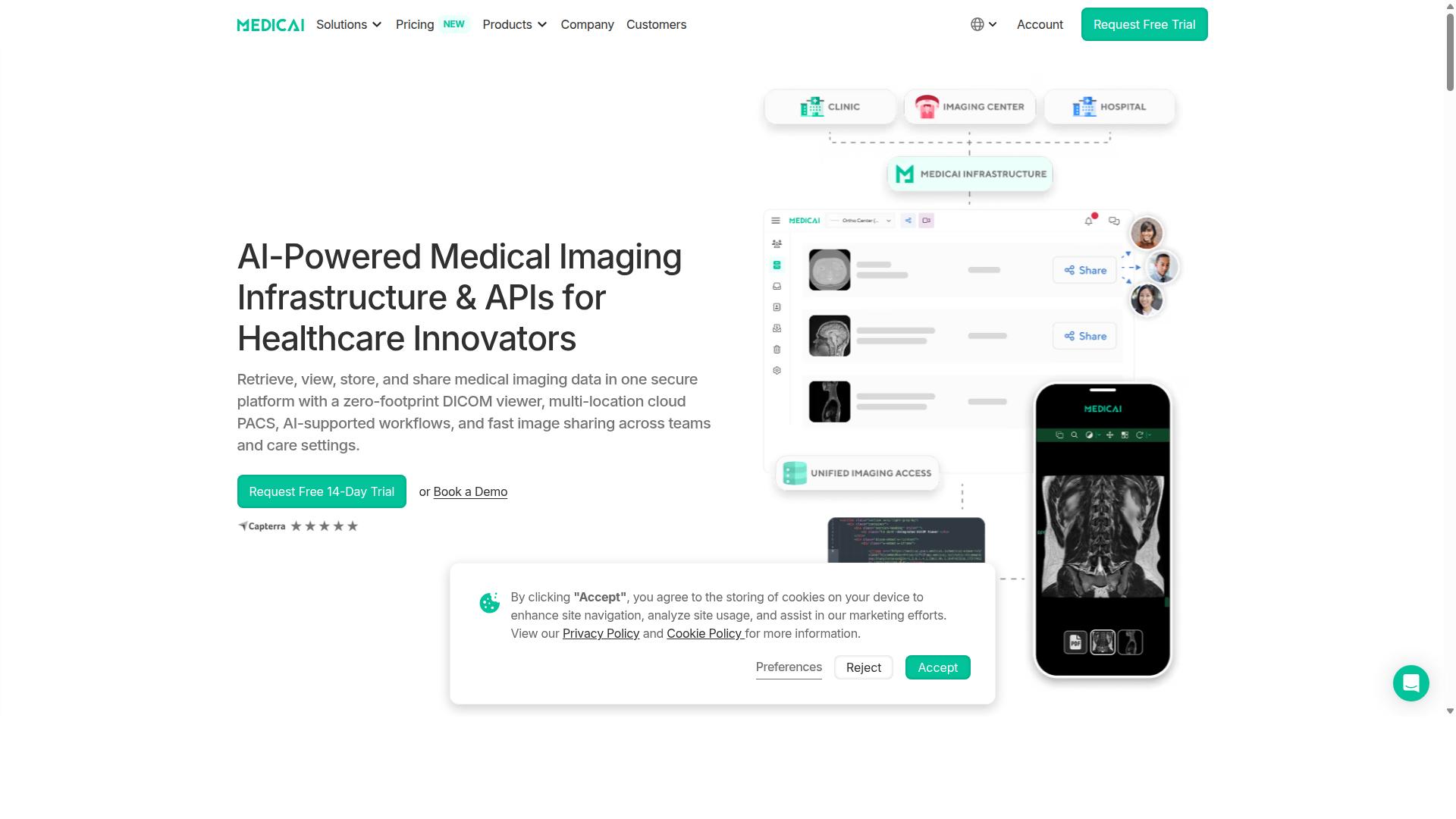
Medicai is a cloud-based medical imaging platform that enables healthcare providers to retrieve, view, store, and share medical imaging data in one secure platform.
The platform operates as a SaaS solution that supports enterprise imaging needs without requiring on-site hardware installations. A zero-footprint DICOM viewer allows users to access studies from any web browser without additional software downloads.
Availability extends globally, which helps organizations with multi-site operations maintain consistent access to imaging data. The system currently manages over 1.7M studies in storage and continues to expand capacity as demand grows.
Core modules include the uploader for transferring studies into the platform, gateway for connecting local devices, archive for long-term storage, exchange for sharing with external partners, and patient case management for organizing related studies and reports.
These components work together to create a unified system that replaces fragmented tools. Healthcare teams can move between viewing, storing, and sharing functions without switching between separate applications.
The modular structure also supports gradual adoption. Organizations can start with essential archive and exchange capabilities then add uploader and case management features as workflows expand.
What Is Intelerad?

Intelerad is a long-standing provider of radiology workflow and enterprise imaging solutions that traditionally combine on-premise servers with optional cloud components.
The typical product stack centers around PACS and RIS modules that manage study routing, modality worklist, and report generation across connected sites. Complementing these tools is a vendor neutral archive designed to consolidate images from multiple vendors into a central repository.
Deployment options often support both on-premise imaging environments and hybrid cloud imaging setups. Multi-site deployment capabilities allow facilities to share studies while maintaining local control over hardware and data residency requirements.
Common radiology workflow elements include image archive functions, teleradiology routing, and basic interoperability through DICOM and HL7 standards. These features address enterprise imaging needs related to scalability, HIPAA compliance, and audit trail tracking.
Integration with EMR or EHR systems usually relies on established messaging protocols, while security measures typically encompass role-based access, SSO, and LDAP or Active Directory support. Load balancing and uptime SLA commitments are part of the platform architecture for larger installations.
What Is Medicai for Enterprise Imaging Solutions?
Medicai's enterprise offering combines a cloud VNA, vendor-neutral archive, and medical image exchange across unlimited user accounts and multiple connected locations. The platform supports both Starter and Standard plans that scale with organizational needs. Each plan delivers core capabilities in image storage, retrieval, and collaboration.
The Starter plan provides 500 GB of storage at $249 per month with one connected location. This option suits smaller teams that need secure image management and basic access controls. Cloud PACS functionality ensures consistent performance across different network conditions.
The Standard plan expands capacity to 2 TB at $749 per month while maintaining one connected location. Additional storage and higher throughput support larger case volumes and multi-specialty workflows. Both plans include backup and disaster recovery features that protect data integrity during outages.
SSO and LDAP integration streamline user authentication across existing directories. These controls reduce administrative overhead while maintaining compliance with role-based access policies. Organizations can connect additional locations as imaging volumes grow without restructuring existing workflows.
Core services include medical imaging uploader, DICOM gateway, cloud PACS, and patient case management. These components work together to support teleradiology and structured reporting needs. The vendor-neutral archive ensures long-term accessibility regardless of source modality or format.
Features Compared
The following two feature areas reveal how each platform approaches common enterprise imaging challenges.
Cloud PACS and Multi-Location Connectivity
Medicai connects unlimited users across multiple locations through its Standard plan's single connected-location option and scalable cloud PACS architecture. The platform offers three pricing tiers: Starter at 249 dollars monthly with no connected locations, Standard at 749 dollars monthly with one connected location, and Enterprise with custom pricing for multiple locations. A one-time DICOM Gateway setup fee of 1,000 dollars applies per location.
Intelerad typically follows on-premise or hybrid multi-site deployment models that require separate infrastructure at each facility. These approaches often involve longer implementation timelines and maintenance overhead across different sites. Latency depends heavily on local network conditions and server capacity.
Medicai's cloud-native design eliminates the need for on-site servers while maintaining data access across locations. Load balancing happens automatically through the cloud infrastructure hosted on Microsoft Azure, Hetzner, and Amazon AWS. Enterprise customers can connect multiple external locations without managing physical hardware at each site.
AI-Supported Workflows and Structured Reporting
Medicai integrates with multiple AI partners such as Rayscape.ai and MD.ai to streamline structured reporting and automated measurements. The platform connects with OHIF and MedDream viewers for consistent image display across locations. These partnerships enable 3D reconstruction capabilities and automated report generation within existing radiology workflows.
Intelerad offers general AI and structured reporting features that vary by deployment configuration. The extent of automation depends on specific module selections and integration requirements. Implementation often requires additional configuration steps at each facility.
Enterprise customers benefit from Medicai's per-study pricing options that scale with usage patterns. The platform supports HL7 and FHIR standards for seamless EMR integration. Custom storage allocations and multiple external location connections provide flexibility as imaging volumes grow across the enterprise.
Pricing Compared
Medicai publishes transparent monthly fees, whereas Intelerad typically engages prospects through custom quotes. This difference affects how organizations evaluate options for enterprise imaging solutions and budget planning cycles.
Medicai offers two standard tiers with clear specifications. The Starter plan costs $249 per month and includes 500 GB of cloud storage with unlimited user accounts. The Standard plan costs $749 per month and provides 2 TB of cloud storage along with one connected location.
Yearly billing provides 15 percent savings on both plans. Organizations pay $209 monthly for Starter and $639 monthly for Standard when billed annually. DICOM Gateway setup requires a separate $1,000 one-time fee per location.
Intelerad pricing remains undisclosed publicly. Potential customers must request custom proposals that typically vary based on deployment scale, user count, and infrastructure requirements. This approach makes direct cost comparison difficult without engaging sales teams.
Enterprise customers of Medicai can access per-study pricing options and custom storage arrangements. The platform also includes a 14-day trial period with no credit card requirement, allowing organizations to test functionality before committing to a subscription.
Who Should Choose Medicai
Hospitals and imaging centers seeking rapid cloud deployment without on-premise hardware should evaluate Medicai.
Specialty care providers in orthopedics, neurology, oncology, radiology and cardiology often need flexible access across multiple sites. Medicai delivers unlimited user accounts, allowing each clinician to sign in from any location without seat restrictions.
The zero-footprint viewer eliminates software installation on local workstations. This reduces IT burden while maintaining diagnostic quality across different devices and operating systems.
Global accessibility supports multi-site deployments where teams work across regions or time zones. Cloud infrastructure removes the need for local servers and simplifies scaling when patient volume grows.
Organizations managing complex imaging workflows benefit from these characteristics. Virtual care providers and teleradiology services can connect specialists without geographic constraints, while clinical trials and tumor boards gain consistent access to studies regardless of participant location.
Patient-facing services also improve when providers adopt Medicai. The Patient Portal enables secure sharing of images and reports, supporting continuity of care without requiring additional infrastructure or dedicated support staff.
Who Should Choose Intelerad
Organizations that prefer on-premise control and already maintain extensive local IT infrastructure may consider Intelerad. These facilities often have established data centers and dedicated teams to manage servers, storage systems, and network configurations.
Traditional hospital systems with complex regulatory requirements sometimes choose this route. They value having physical servers located within their own facilities for certain compliance and security reasons.
Large radiology groups that operate across multiple sites may also examine on-premise or hybrid solutions. These organizations typically need consistent control over data routing and study distribution across different locations.
Facilities with existing PACS and RIS investments sometimes prefer keeping their current setup rather than migrating systems. They want to maintain familiar workflows and avoid disrupting established processes.
Groups that handle sensitive imaging data in highly regulated environments may examine these options carefully. They often have specific policies about where patient information can be stored and accessed.
Who Should Choose Medicai for Enterprise Imaging Solutions
Large health systems managing multiple connected sites and requiring vendor neutral archives can leverage Medicai's Standard tier.
Systems with high volumes of imaging data benefit from 2 TB storage included in the plan. This capacity supports radiology departments that generate frequent studies across different locations without immediate need for additional storage upgrades.
Multi-site deployments gain from one connected location that unifies access to archived studies. Consolidated storage reduces the complexity of maintaining separate archives at each facility while preserving performance for remote reads.
Staffing models that involve many clinicians or external partners find value in unlimited user accounts. This feature simplifies account management when onboarding new radiologists, referring physicians, or teleradiology groups without incremental licensing costs.
Security and continuity features add another layer of suitability. Backup and disaster recovery protect studies against data loss, while role-based access controls restrict viewing and editing privileges according to clinical or administrative responsibilities.
Organizations that already rely on DICOM Gateway or Medical Imaging Uploader for ingestion can extend those tools across sites. The same infrastructure supports both internal workflows and external image exchange without duplicating hardware investments.
Compared with Intelerad, Medicai's tier structure places fewer restrictions on user scale. Intelerad offerings often tier user counts, which can create budget pressure when staffing expands or when temporary specialists join the network.
Systems evaluating vendor neutral archive options also consider integration breadth. Medicai's Cloud PACS and Vendor Neutral Archive provide a foundation that accommodates HL7 and FHIR connections for EHR synchronization across the enterprise.
Final Verdict
Medicai's cloud-first architecture, transparent pricing, and 1M+ annual studies processed make it a strong contender for facilities prioritizing scalability and speed of deployment. Organizations that need quick implementation across multiple locations often find cloud systems reduce the time spent on hardware setup and maintenance. These factors help teams focus more on patient care rather than infrastructure management.
The FDA/CEE cleared viewer provides diagnostic quality imaging on any device without requiring local software installation. This capability supports teleradiology workflows and enables radiologists to read studies from remote locations with confidence. The zero-footprint viewer also reduces the need for IT teams to manage workstation updates or security patches.
Medicai processed over 50M API transactions, which demonstrates its ability to handle high volumes of data exchange across different systems. This level of interoperability matters for hospitals that must connect PACS, RIS, and EHR platforms while maintaining consistent performance. The platform supports HL7 and FHIR standards to facilitate these connections.
Both HIPAA and GDPR compliance are built into the system design, which addresses the regulatory requirements of healthcare organizations operating in multiple regions. Role-based access controls and audit trails help facilities track who accessed patient data and when. These security features support compliance documentation during audits.
Intelerad's on-premise solutions may appeal to organizations that prefer keeping imaging data within their own data centers. However, this approach typically requires significant upfront investment in hardware and ongoing maintenance resources. Multi-site deployments often face challenges with data synchronization and remote access.
Facilities evaluating both platforms should consider their current infrastructure, growth plans, and internal IT capabilities. Research suggests that cloud imaging solutions reduce capital expenses while improving deployment speed across distributed radiology departments. The choice often depends on whether the organization values rapid scalability or maintains existing on-premise investments.
Medicai USA is located at 7901 4th St N, STE 300, St. Petersburg, FL, 33702. Organizations can reach the team at +1 (832) 220 1035 or [email protected] to discuss specific enterprise imaging requirements.
Recommended Resources: